
From Curiosity to Circuits: My First Step into Robotics

I’ve always been curious about how things work.
It probably has a lot to do with my engineering background. Whenever I come across a process, a machine, a technology, or even a concept I don’t fully understand, the same question almost always comes up: what’s really happening here?
This time, that curiosity led me to electronics.
I wasn’t trying to become an expert or take on a particularly ambitious project. I wanted something much simpler: to start from scratch and, above all, learn by doing.
I wanted to understand what happens when we connect a sensor to a circuit board. How a signal becomes information. How a few lines of code can activate a motor. How components that seem fairly simple on their own end up working together as a system.
I could read about all of this, of course. But I wanted to get my hands on it, connect things, make mistakes, and get it working.
A box full of possibilities
While looking for a practical way to get started, I found a SunFounder kit on Amazon based on the Arduino Uno R3.
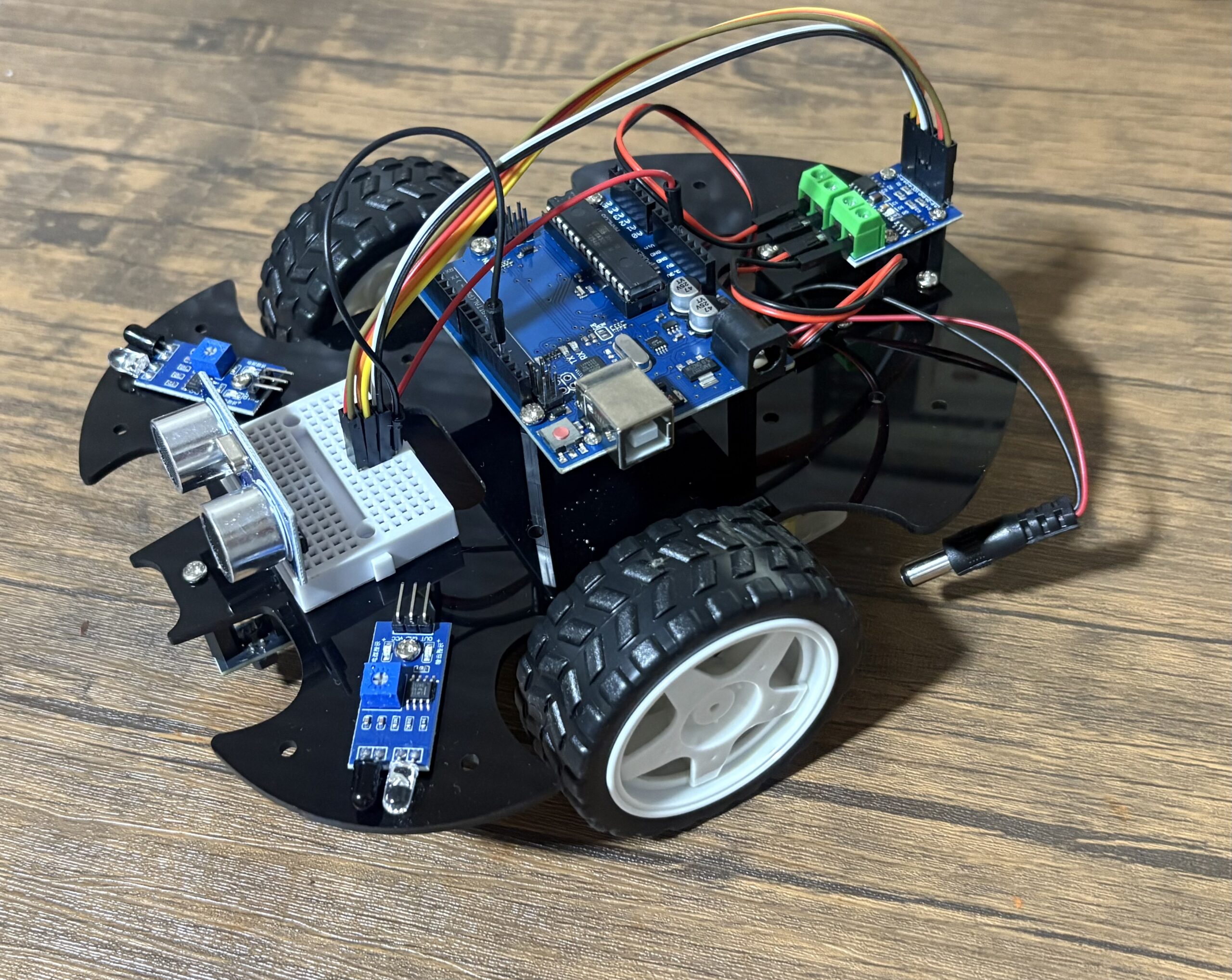
What first caught my attention was that one of its projects was a small smart car: two motors, wheels, sensors, an Arduino-compatible board, and enough components to experiment without having to design everything from scratch.
So I bought it.
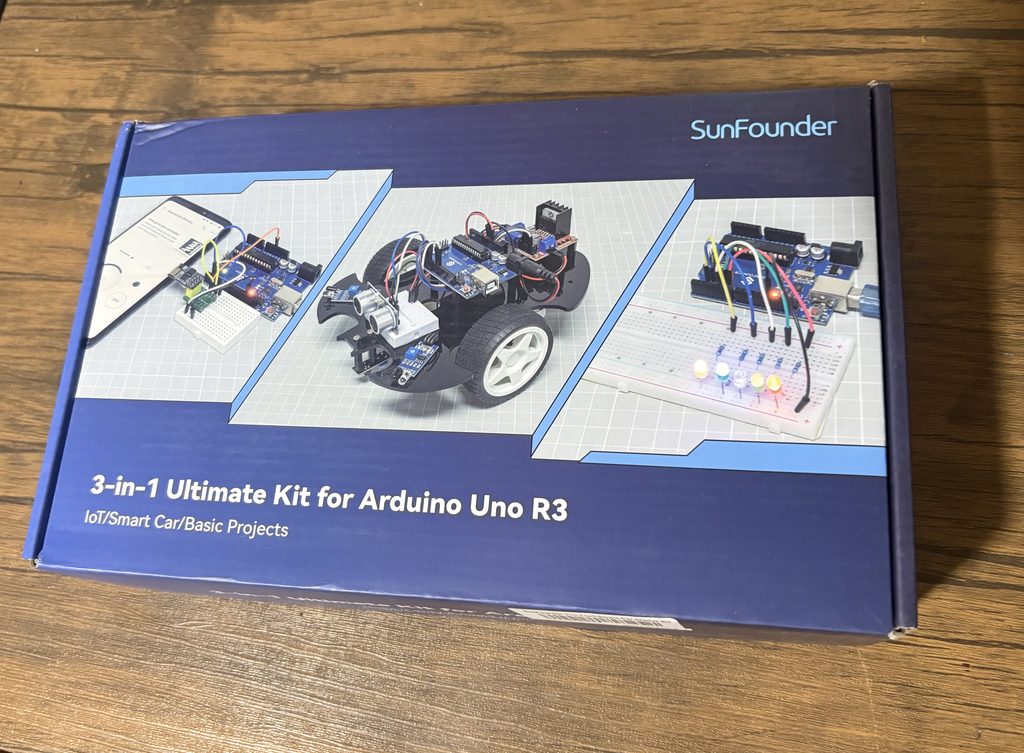
When I finally opened the box, I found more than I’d expected: resistors, LEDs, infrared sensors, an ultrasonic sensor, a small servo motor, an LCD screen, a Wi-Fi module, breadboards, motors, controllers, and plenty of parts whose functions I still had to learn.
There wasn’t a robot on the table. There were components. And that was exactly what made it interesting.
Starting with the basics
My initial goal was simply to build the car and understand what each part did.
I didn’t want to just follow a diagram, connect some wires, and upload a program that made the vehicle move. I wanted answers to some fairly basic questions:
- How can a sensor detect an object in front of it?
- How can it estimate how far away that object is?
- How do you control two motors using Arduino?
- What does making a robot turn actually involve?
- What happens between an instruction written on a computer and a wheel starting to move?
For someone who works with electronics every day, these are probably elementary questions. For me, they were new. And that was precisely what made them interesting.
From parts to a system
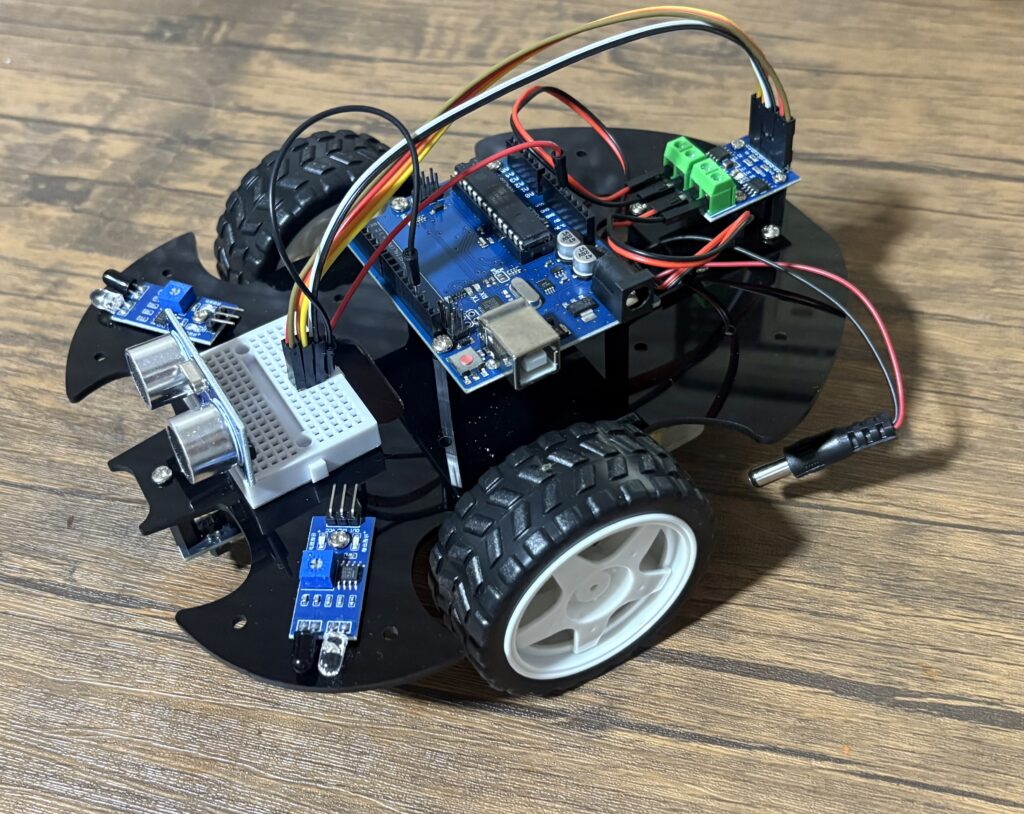
I started assembling the car by following the kit’s instructions: first the chassis, then the motors, wheels, board, motor controller, sensors, and finally the wires.
Little by little, what had started as a collection of components became something different: a system.
That felt familiar. Something similar happens in engineering and process improvement: understanding each component on its own doesn’t necessarily mean understanding how the whole system behaves. Often, the most interesting things emerge from the interactions between the parts.
A sensor takes measurements. A motor moves. The board executes instructions. But by coordinating these functions, the system can do something no single part could do alone: detect certain aspects of its surroundings and move the vehicle in response.
A question I hadn’t planned to ask
Up to that point, the project was exactly what I’d imagined: an enjoyable way to learn electronics and programming.
The next logical step would have been to program the car to move forward, detect obstacles, and change direction. Something like:
If you detect an object closer than a certain distance, stop and turn.
But while I was putting it together, another question came to mind. The kind that seems small at first, then starts opening the door to others:
What if, instead of programming exactly what it should do, I tried to let it figure some things out for itself?
In the example above, the robot isn’t learning from experience. I choose what distance counts as dangerous, program it to stop, and decide which way it should turn. The robot follows the rules I’ve given it.
So I started wondering about something different:
Could a robot start without those behavioral rules and gradually adapt them through experience?
At that point, I didn’t have an answer. I also had no idea how far that question might take me.
The little car on my desk began to look like more than an electronics exercise. It could become a platform for exploring a much broader question: how does learning happen?
Learning by doing
For now, I’m exactly where I wanted to begin: learning about electronics, Arduino, sensors, programming, and robotics. And probably many other fields that will come into the picture along the way.
I think that’s one of the things that draws me to this project. It didn’t start because I knew how to build robots. It started because I didn’t. And because I wanted to understand.
Today, there’s a small assembled car on my desk, several sensors, some wires, and many more questions than I had when I bought the kit. I think that’s enough to get started.
As I finished putting it together, a more personal connection came to mind. I’ve been thinking a lot about how a child learns while exploring the world: how they begin to connect movements, sensations, consequences, and experiences.
I don’t think a robot learns in the same way a child does, but that image inspired another question:
Could I try to get this little robot to learn from something like a starting point of zero?
That “zero” wouldn’t be literal: I would still have to decide what it can sense, which actions it can take, and how to evaluate what happens. What I want to explore is how much of its behavior could develop through experience, rather than being given a rule for every situation.
That will be the next part of this story.